Bangladesh’s Textile Industry Shift: From Basic Garments to Value-Added Products
Bangladesh is one of the strongest names in the global textile and garment industry. For decades, the country has built its reputation mainly on basic garment exports like t-shirts, trousers, shirts, and knitwear. This foundation has helped Bangladesh become the second-largest apparel exporter in the world and has created millions of jobs across the country.
But the global market is changing very fast.
Today, competition is no longer only about low cost. It is about innovation, design, quality, and product value. Buyers from Europe, the USA, and other major markets are now looking for suppliers who can deliver more than just basic clothing. This is where the concept of value-added textile products becomes extremely important for Bangladesh’s future.
What Does “Value-Added” Really Mean?
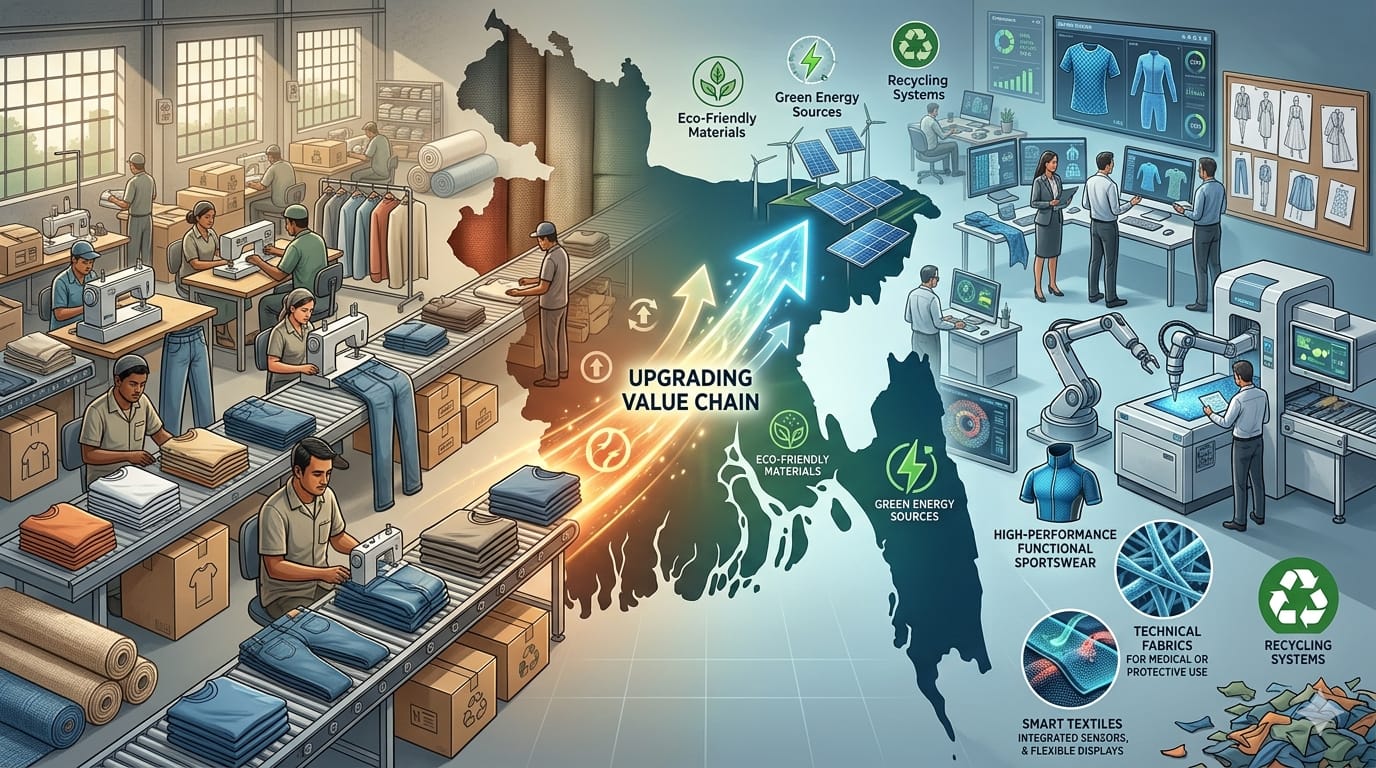
Value-added textile products are those that go beyond basic manufacturing. Instead of only producing simple garments, the focus shifts toward more advanced and specialized products such as:
- Functional clothing (sportswear, activewear, moisture-control fabrics)
- Technical textiles (medical textiles, protective uniforms, industrial fabrics)
- Fashion-oriented premium garments with advanced design and branding
- Eco-friendly and sustainable fabric-based products
- Smart textiles with performance features like UV protection or temperature control
These products require more skill, better design, research, and modern technology—but they also bring much higher profit per unit.
Why This Shift Is Important for Bangladesh
If Bangladesh continues to depend mostly on basic garments, it will face serious challenges in the future. Countries like Vietnam, India, and other emerging players are already competing aggressively in low-cost production. At the same time, global buyers are pushing for higher quality and more innovative products.
So, moving toward value-added textiles is not just an option—it is becoming a survival strategy.
One of the biggest advantages of this shift is profitability. Basic garments operate in a highly competitive market where margins are very low. But value-added products allow manufacturers to earn significantly more from the same production capacity.
Another major benefit is stronger buyer relationships. When factories can offer design, innovation, and specialized products, international brands rely more on them instead of switching suppliers only for cheaper prices.
Economic and Industrial Impact
If Bangladesh successfully develops this sector, the impact will be huge:
- Export earnings will increase without depending only on volume
- Factories will become more technologically advanced
- Skilled jobs in design, engineering, and R&D will grow
- The industry will move closer to global sustainability standards
- Bangladesh’s global image will improve from “low-cost supplier” to “value-driven manufacturer”
The Biggest Challenge
However, this transformation is not easy. Bangladesh still needs improvement in several areas such as:
- Lack of strong research and development (R&D)
- Limited product innovation culture
- Dependence on imported machinery and design ideas
- Skill gap in technical textile production
- Weak collaboration between industry and academia
These issues must be addressed step by step through investment, training, and long-term industrial planning.
Final Thought
Bangladesh has already achieved remarkable success in the textile industry. But the next stage of growth will not come from producing more basic garments—it will come from producing smarter, more advanced, and higher-value products.
The future belongs to countries that can combine manufacturing strength with innovation and design capability. If Bangladesh can make this shift successfully, it will not just remain a garment exporter—it will become a global leader in value-added textiles.